← Back to blog index · 2026-05-10
funding market vs Aave / Compound DeFi Lending — Why CeFi Funding Wins on Yield
Aave USDC typically 3-6% APY, Compound USDC 2-5%. CeFi funding on the exchange runs 14-16% net median. Real comparison, risk structure analysis, why DeFi lending yields can't catch CeFi funding.
DeFi lending protocols like Aave and Compound are the entry-level choice for stablecoin yield — friendly UI, on-chain transparency, smart contracts proven over years.
But the actual yield numbers are modest: Aave USDC supply has typically run 3-6% APY across 2024-2026 (see defillama.com/protocol/aave), Compound USDC ~2-5%. Same window, our walk-forward backtest puts funding market fUSD balanced at ~16% median net APY (with spikes well above).
Why does CeFi funding systematically beat DeFi lending? This post explains the structural reasons and clarifies when DeFi is actually the better choice.
TL;DR
- Yield: CeFi funding ~16% median > Aave 3-6% > Compound 2-5% (typical 2024-2026 ranges, defillama)
- Liquidity: Aave/Compound instant withdraw > the funding market 2-120 day lock
- Risk: the venue (borrower default + platform) vs DeFi (smart contract + oracle)
- Capital floor: DeFi has none, the venue effectively $500+
- Gas fees: DeFi ops cost gas; small accounts get eaten
Why CeFi Funding Wins Structurally
DeFi lending rates are determined by excess borrow demand vs excess supply. In practice:
- Aave USDC supply is high, demand is low → rate compressed
- Compound similar
- Big capital has cheaper alternatives (institutional OTC), doesn’t come to DeFi
This funding market’s rates are determined by margin trader leverage demand:
- BTC/ETH rallies → traders open leverage → funding rates spike
- Crypto culture is leverage-heavy → structurally high demand
So even with the venue’s 15% fee cut, net yield still beats DeFi 1-3x.
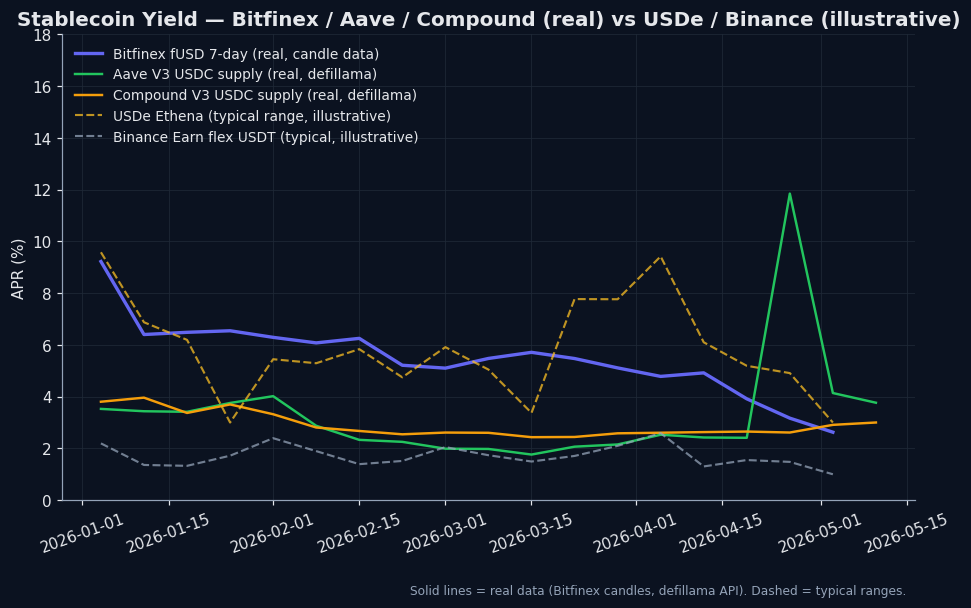
One Chart — The Comparison
Weekly yield comparison across 2026 (fUSD real candle median; Aave / USDe / Binance shown as typical 2026 ranges, not exact daily values):
Real Capital Comparison
$10K USDT, annual interest using mid-range estimates:
| Platform | APY (net) | Annual interest | Liquidity |
|---|---|---|---|
| Compound USDC | ~3% | ~$300 | Instant |
| Aave USDC | ~4.5% | ~$450 | Instant |
| fUSD on the venue (multi-bucket, walk-forward median) | ~14% | ~$1,400 | Avg 5-30 days |
Scaled to $50K: the venue’s ~14% median yields ~$4,500-5,000 more per year than Aave’s typical range. Liquidity for yield is a fair trade if you can lock for ~30 days.
(Funding number from realistic_backtest.py walk-forward median, λ=1.0 calibrated; deliberately under the 15.7% backtest median to leave headroom for live execution.)
DeFi’s Real Strengths
The funding market isn’t universal. DeFi wins in these scenarios:
1. Instant Liquidity Need
If your capital might be needed within 24 hours, Aave allows instant withdrawal. The exchange’s minimum lock is 2 days.
2. No KYC
The exchange blocks US IPs and requires KYC elsewhere. Aave is purely on-chain, KYC-free.
3. Smart Contract Composability
If you want yield to feed into automated strategies (e.g., leveraged farming), DeFi composes natively.
4. Sub-$500 Capital
The platform’s $150 minimum funding offer plus practical fees mean effective entry ~$500. Aave has no minimum (only gas fees).
5. Trustlessness
If you fundamentally distrust CEXes, DeFi’s “no intermediary” philosophy is the value, not the yield.
Risk Structure Comparison
CeFi Funding
- Exchange insolvency (none historically; insurance fund covers)
- Borrower default (insurance fund pays)
- Can’t withdraw mid-lock (except borrower prepayment)
- Smart contract risk: 0 (no contracts involved)
Aave / Compound
- Smart contract bug (theoretically protocol can be hacked; Aave has had oracle incidents)
- Oracle attack (multiple in 2024)
- Underlying asset (USDC) depeg (March 2023 SVB event saw USDC drop to $0.87)
- Governance attack (token-based governance can be manipulated)
Both carry risk, structurally different. CEX risk concentrates (one failure point); DeFi distributes (multiple small failure points).
When to Pick Which
| Scenario | Recommendation |
|---|---|
| Primary yield, can lock 2-30 days | CeFi funding |
| Emergency funds, instant access needed | Aave / Compound |
| Large capital ($50K+), maximize yield | CeFi funding |
| Small capital (<$1K), learning DeFi | Aave |
| Distrust CEX, DeFi believer | Aave |
| Distrust smart contracts, CeFi believer | CeFi funding |
| Want both | 80% CeFi funding + 20% Aave |
Automation Options
Aave/Compound generate yield passively, no bot needed.
This funding market requires a bot to run efficiently — recommend Yieldsforge ($60/yr flat) or see the full funding bot comparison.
Related Reading
- CeFi funding vs USDe Ethena — Full Comparison
- The exchange vs Binance Earn vs OKX Earn
- How the venue’s 15% fee actually works
- Why CeFi funding beats DeFi yields — the hub
Disclosure: I’m the developer of Yieldsforge. Aave/Compound data from defillama.com, funding data from public candle data. Not investment advice.
Want to put your USDT on autopilot?
Free plan available forever. No credit card required.
Get started free