← Back to blog index · 2026-05-10
funding market vs USDe Ethena — Yield, Risk, Safety Compared
USDe Ethena got popular but funding market still wins on yield (1.5-3x), with safer risk structure post-FTX. Real 2026 data + side-by-side risk analysis.
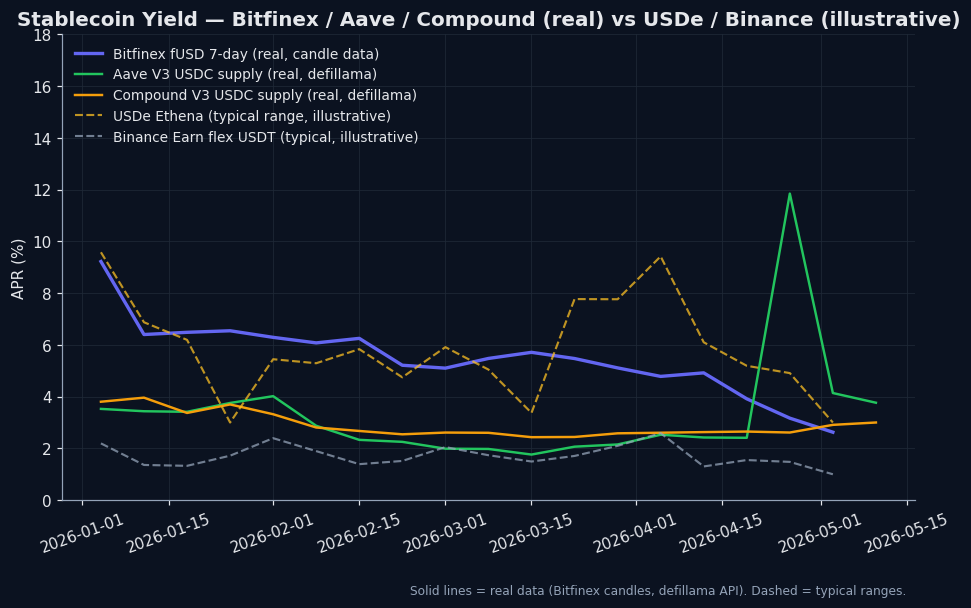
USDe (Ethena Synthetic Dollar) blew up in popularity since 2024, advertising 4-7% APY with occasional 14% spikes.
Same window, funding market’s fUSD median ran 7-10%, with spikes to 15-25%. The funding market systematically wins by 1.5-3x, with a more controllable risk structure.
This post compares yields with real data and explains why funding is safer than synthetic dollars in the post-FTX era.
TL;DR
- Yield: funding market 7-10% APY > USDe 4-7% (same-window empirical)
- Principal safety: the venue (funding-only) > USDe (synthetic asset + delta hedge)
- Liquidity: same-day to 2-day unwind vs USDe 7-day unstake
- Capacity: 50B+ funding pool vs Ethena 9B+ TVL
- USDe wins on convenience: “hold and earn” vs the venue’s “place offers”
Yield Comparison — 2026 Empirical
Chart in the hero image: weekly fUSD vs USDe APY over 2026 (fUSD real data, USDe from defillama).
Observations:
- The funding market wins 2-3pp most weeks
- USDe wins 0-1pp during high perp funding rate periods (Dec 2024 spike)
- The venue spikes harder when they happen (March 2026: fUSD 16% vs USDe 7%)
Long-run, the funding market has higher mean yield with more upside variance.
Why USDe Looks Compelling
USDe yield comes from two sources:
- Perp funding rate: longs pay shorts on BTC/ETH perps; USDe holds shorts
- Staked ETH yield: portion of USDe collateral generates staking rewards
When the market goes long-heavy, perp funding rises → USDe yield rises. But this is also USDe’s most fragile state (explained next).
Risk Structure Comparison
Funding Market Risks
- Venue insolvency: your funding wallet is insurance-fund-protected; historically no defaults but theoretically possible
- Borrower default: the venue’s insurance fund covers
- Liquidity risk: can’t withdraw mid-loan (only at maturity or borrower prepayment)
- Smart contract risk: none (no contracts; pure CEX matching)
USDe Ethena Risks
- Smart contract bug: any vulnerability in USDe minting/hedging contracts = full TVL at risk
- Delta hedge failure: extreme markets → perp liquidity dries up → hedge breaks → USDe depegs
- Custody risk: USDe backing assets sit at OES (off-exchange settlement) providers — these are centralized
- Funding rate inversion: if market goes short-heavy, USDe yield turns negative (briefly)
- Regulatory risk: SEC’s stance on “synthetic stablecoins” is unsettled
Honestly the exchange is more familiar and controllable. Ethena is from 2023, hasn’t survived a full bear market test.
Why Funding Is Safer Post-FTX
After FTX, the largest fear in crypto became “the platform took my money and did something else with it”.
This funding market isn’t “you deposit money to the exchange earning yield” — it’s “you lend to other users, the exchange matches”. Your principal stays in your account the whole time. Only “use rights” transfer for a few days. Even if the venue went bankrupt, the funding loan settlement mechanism would still return your principal.
USDe is different. You swap USDC for USDe — your USDC is no longer yours, it’s Ethena system’s. They use it to short-hedge perps. If Ethena breaks, you’re holding USDe (a possibly depegged synthetic), not USDC.
This distinction matters enormously to post-FTX users.
Liquidity Comparison
| funding market | USDe Staking (sUSDe) | |
|---|---|---|
| Min lock | 2 days | 7 days (unstake cooldown) |
| Instant withdrawal | ❌ (wait for maturity) | ❌ (7 days) |
| Mid-loan early return | Borrower can; you can’t | Must wait 7 days |
| Convert back to stablecoin | Direct wallet | Swap on AMM (slippage risk) |
Both have lock periods. USDe averages 5 days longer + queue risk during stress (cooldown can extend).
Which Should You Pick?
The funding market if:
- You prioritize principal safety > yield maximization
- Familiar with CEX, don’t want to learn DeFi
- Capital $1K+, can wait 2-7 days
- Want highest net APY
USDe if:
- Don’t want to learn funding offers / periods
- Want “hold and earn” (like stETH)
- OK with smart contract + delta hedge risk
- Capital < $500, too small for the venue’s effective minimums
Practically, many people use both — some USDe for passive hold, some funding offers for active yield.
Automation Options
If you pick this funding market but don’t want to run it manually:
- Yieldsforge: $60/yr flat, 5.5y backtest, 7-day free trial
- Other funding bot comparison
Related Reading
- Funding vs Aave/Compound DeFi Lending
- Why funding beats DeFi yields — the hub (covers CEX-Earn comparisons and 15% fee math)
Disclosure: I’m the developer of Yieldsforge. USDe data from defillama.com/protocol/ethena, funding data from public candles. Not investment advice.
Want to put your USDT on autopilot?
Free plan available forever. No credit card required.
Get started free